
The 24th Young Scholars Series of Medical Humanities Forum:Emily Graf: A History of Anatomical and Pathological Collections in China
On the morning of April 7, 2026, the 24th Young Scholars Series of Medical Humanities Forum titled The Materiality of Medical Science: A History of Anatomical and Pathological Collections in China, was held in Room 620, Yifu Building. The lecture was organized by the School of Health Humanities at Peking University. The presenter was Professor Emily Graf from the Department of Sinology at the University of Tübingen, Germany. The session was moderated by Associate Professor Su Jingjing from Peking University’s School of Health Humanities. Discussants included Professor Chen Chunhua from Peking University’s School of Basic Medical Sciences and Associate Professor Chen Qi from the School of Health Humanities. Over ten faculty members and students from Peking University and other institutions attended the lecture.
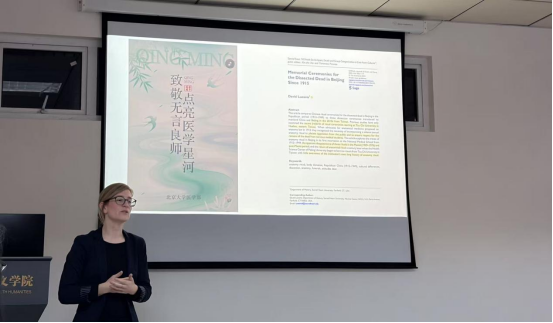
Professor Graf began by reviewing the development of memorial ceremonies for anatomical donors since the 20th century. In recent years, new objects and elements have been introduced and associated with specific spatial arrangements, creating new associations while continuing traditions. She noted that such ceremonies are globally prevalent, blending political and religious elements within a complex, multicultural context.
Professor Graf then posed a series of core questions: Where does medical knowledge arise, and how is it transmitted? How was the “normal” and the “pathological” not simply discovered but produced in macroscopic and microscopic collections of medical schools in China? By whom, how, and why? She acknowledged that her theoretical framework is inspired by works such as Laboratory Life: The Construction of Scientific Facts and by Georges Canguilhem's view that “normal” and “pathological” are normative states, not pre-existing scientific facts, thus emphasizing the constructed nature of “normality”.
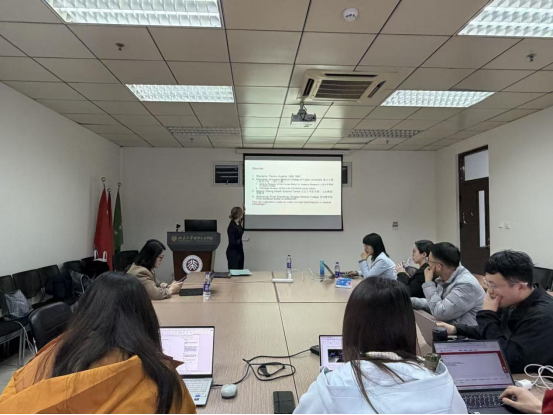
Addressing these questions, Professor Graf used case studies of pathological specimen collections in various regional hospitals to examine the central concern: “How do these collections construct the binary order of normal and pathological in medical knowledge?”
Addressing these issues, Professor Graf examined how pathological specimen collections from hospitals in different regions have shaped the binary order of “normal versus pathological” within medical knowledge. The first case study, based on a 1945 manuscript from the German Consulate in Shanghai, explored the history of Shanghai’s Paulun Hospital (1899–1942). Prior to 1913, the hospital faced legal obstacles in obtaining cadavers for autopsy; it was not until 1924, when a new agreement was signed with the Shanghai courts, that it gained legal access. During this period, the hospital endured the turmoil of Japanese bombing raids, which led to the destruction and relocation of the collection. However, as a foreign hospital, the actual implementation of the legal measures was limited, and early Sino-foreign medical collaborations were complicated by ambiguities as China increasingly aimed to work independently in medical education. In the second case study, Professor Graf traced the institutional history of the pathological specimen collection at Fudan University’s Shanghai Medical College. She analyzed a 1930 fetal autopsy report and shows that Chinese doctors formally published the case report and photographs of the pathological specimens in a specialized German medical journal in 1932, circulating them within the international academic community. Due to the era in which it was written, the 1932 German article also incorporated factors such as race and family history, revealing the concept of race underlying the medical standards and scientific rhetoric of the time. In the third case study, Professor Graf highlighted pathologist Dr. Gu Jingqian’s emphasis on specimens. She analyzed a 1958 liver specimen which is likely to have been included in his teaching materials, to discuss a schistosomiasis case, and explained how the museum interprets “normal” and “pathological” liver specimens in its display. In addition, the lecture discussed the history of the “Shangyi” Pathology Specimen Exhibition Hall, as well as the efforts of medical figures such as Yan Fuqing and Gu Jingqian to establish specimen databanks and their willingness to donate their own bodies to advance the cause of specimen collection. Finally, in the fourth case study, Professor Graf introduced the collection of acupuncture anatomical specimens at the Anatomy Museum of Peking University Health Science Center, emphasizing that while these specimens were common in medical schools across the country in the early 1970s, they are now rare historical traces of a specific time in history which aimed to introduce Chinese medical paradigms into anatomical displays.
Yifan Gao
School of Health Humanities
