
The Inaugural Public Development Finance Observer Flagship Report Launched at the Eurasian Development Bank's 20th Anniversary Annual Meetin
From June 25–26, 2026, Peking University's Public Development Finance Research Program launched the inaugural report of the Public Development Finance Observer Series—"Artificial Intelligence Empowerment of Public Development Financial Institutions"—at the Eurasian Development Bank's (EDB) 20th Anniversary Annual Meeting and Business Forum in Almaty, Kazakhstan. Held under the theme "Eurasia 2030+: Investments, Growth and New Opportunities," the forum drew diverse participants from EDB member states, multilateral development banks, international organizations, enterprises, investment institutions, academia, and think tanks. The report launch drew broad attention and generated significant interest among attendees.
The Public Development Finance Observer Series is a flagship intellectual product of the Program, designed for researchers, practitioners, and policymakers. It aims to synthesize the latest developments in public development financial institutions (PDFIs), inspire peer practitioners by analyzing pilot solutions to common challenges, and equip readers with curated evidence and actionable insights.
As the inaugural issue, "Artificial Intelligence Empowerment of Public Development Financial Institutions" examines how PDFIs are deploying AI across four domains: inclusive and tailored access, operational execution, proactive risk management, and integrated knowledge management and institutional learning. The report finds that AI holds significant potential to help PDFIs better fulfill public policy objectives, yet evidence remains largely descriptive rather than evaluative. Governance risks—including algorithmic bias, opacity, and potential exclusion—are clear. The report concludes that PDFIs should govern AI responsibly by building transparent data foundations, growing AI literacy across all staff, keeping humans accountable for consequential decisions, testing high-risk AI in regulatory sandboxes, and measuring effectiveness—not just efficiency.
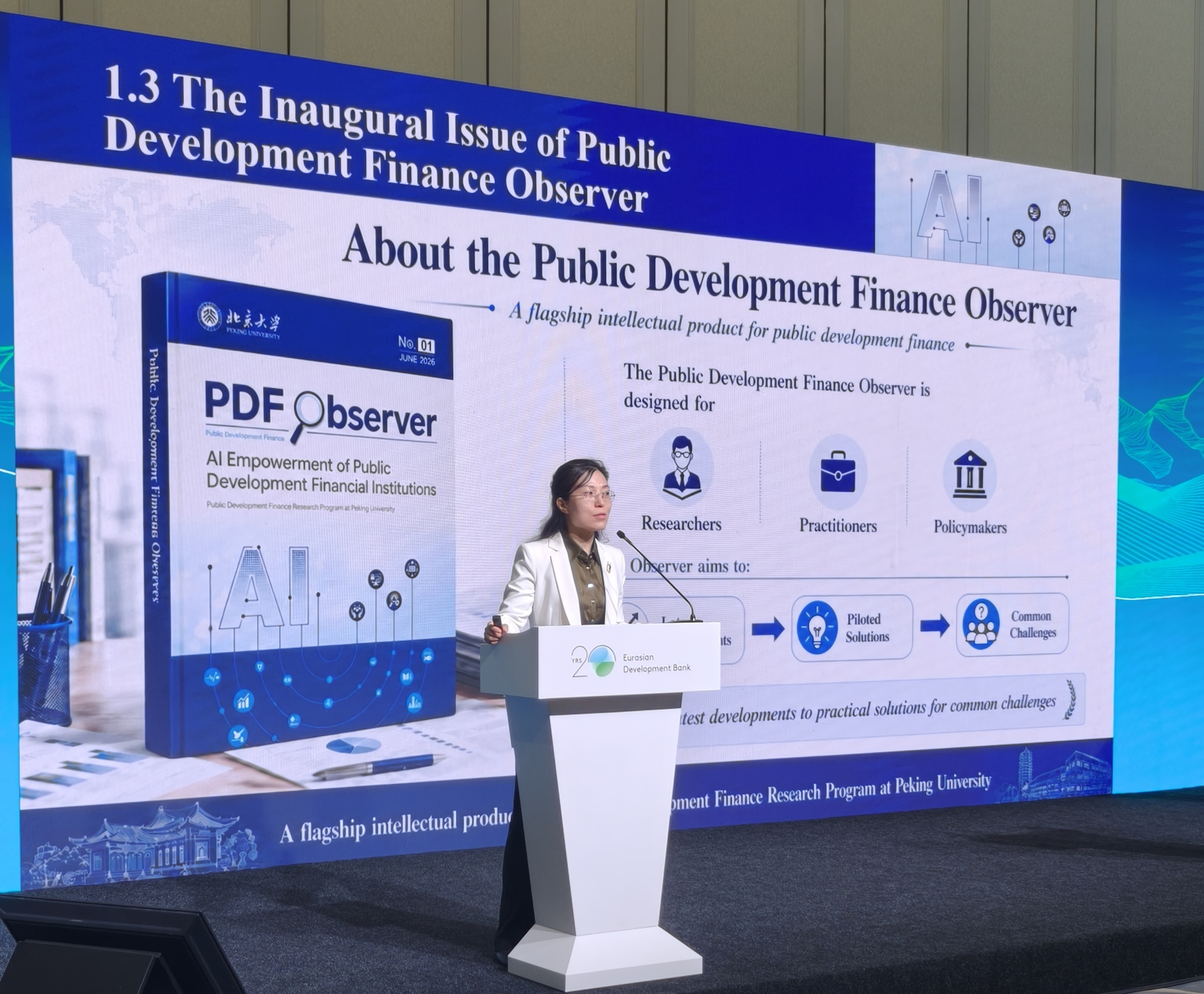
(Professor Jiajun Xu, Principal Investigator of Public Development Finance Research Program at PKU, launched the inaugural report of PDF Observer Series at the EDB’s 20th Anniversary Annual Meeting and Business Forum)
The report has received endorsements from three internationally renowned experts:
· Professor Xiaolan Fu (University of Oxford, Founder of OxValue.AI, United Nations High-level Advisory Board member) commends the report for systematically mapping AI deployment across four operational domains while balancing technological promise with sober governance analysis on human oversight and institutional learning.
· Rémy Rioux (Chair of Finance in Common) praises the report as a practice-grounded analysis and an essential strategic roadmap for the Finance in Common community in navigating AI opportunities and governance challenges.
· Professor Lan Xue (Dean of the Institute for AI International Governance at Tsinghua University, Chair of China's National Expert Committee on AI Governance ) observes that as AI reshapes global governance, this pilot report addresses concrete AI applications while squarely tackling algorithmic bias, transparency, and accountability—calling it a foundational reference for policymakers and scholars in development finance.
The successful launch of this inaugural report marks a significant milestone for the Public Development Finance Research Program at Peking University. Co-built by the Institute of New Structural Economics and the School of Health Humanities, the Program builds on its foundational database on PDFIs to advance evidence-based frontier research and foster policy dialogue to become a globally recognized research hub on public development finance.
About Public Development Financial Institutions
Public Development Financial Institutions (PDFIs) are public financial institutions established by governments to proactively achieve public policy objectives. These institutions potentially serve as potent policy instruments for addressing market failures, incubating emerging markets, delivering global public goods—such as pandemic prevention and climate change mitigation—and promoting equitable and sustainable economic structural transformation, as well as advancements in health and education.
Yet due to lack of data, myths persisted—that PDFIs were marginal, inefficient, or obsolete. To fill the gap, Public Development Finance Research Program at PKU initiated to build the first global database on public development banks and development financing institutions in collaboration with AFD and FERDI. The original database reveals that PDFIs are both prevalent and pivotal worldwide. The database identifies over 550 PDFIs across more than 150 countries, with aggregate total assets exceeding US$23 trillion. This evidence helps to move the debate from ideology to fact, as the international agenda is no longer about whether we need PDFIs, but how to make them work better. The historic Sevilla Commitment, as endorsed by UN member states at the 4th International Conference on Financing for Development (FfD4) in July 2025, now explicitly encourages countries to establish and strengthen PDBs to fulfill their potential for achieving Sustainable Development Goals.
Download the report: QR code

Register to download the open-source database on PDBs and DFIs: QR code